
Guides
Vacation homes prices compared with what actually happens
Vacation home asking prices in four markets are compared with carrying costs, taxes and resale gaps that decide what a second home really returns.
What to take away
- Vacation home prices are the smallest number in the purchase. Carrying cost, transfer tax and resale friction decide what the year returns.
- Five markets with published median sale prices give you a starting point: Cape Cod, Park City, the Hamptons, Hilton Head and the Outer Banks.
- A home rented short-term is a regulated business. Zoning, registration, code classification and assessment each apply separately.
- Non-resident withholding and transfer taxes are the costs buyers discover at closing, not at listing.
- Write the arithmetic in your own numbers before you tour. The formula matters more than any figure quoted to you.
Asking price against what the year costs
A vacation home is priced like a house and operated like a business. The listing shows the first number. The year shows the rest.
Start with published median sale prices, because they are checkable and they set the range. On Cape Cod, Massachusetts, single-family medians typically run $700,000 to $850,000, and waterfront property sells well above that.
Park City, Utah sits higher still, typically $2 million to $3 million for a single-family house. The Hamptons on Long Island run higher again at $1.2 million to $1.8 million. Hilton Head, South Carolina sits below the first three, near $650,000 to $900,000.
Those medians come from local listing services and county deed records, and they move every quarter. The Cape Cod & Islands Association of Realtors, the Park City Board of Realtors, Douglas Elliman's Hamptons reports and the Hilton Head Area Association of Realtors publish them.
Pull the current figure from the registry in the county you are considering rather than trusting a number you read anywhere, this page included.
Then add the year. Property tax comes first, at the local assessment rate, and Cape Cod towns typically levy $7 to $10 per $1,000 of assessed value. Coastal insurance on a $750,000 house commonly runs $3,000 to $6,000, with wind deductibles set at 2% to 5% of the dwelling limit.
Flood coverage through the National Flood Insurance Program caps building coverage at $250,000 on a single-family home. A $750,000 coastal house often needs a private excess policy above that.
Utilities run on a house that sits empty. The lawn and the pool still need contracts, and snow removal, a property manager and association dues each add a line item.
The arithmetic is yours to run:
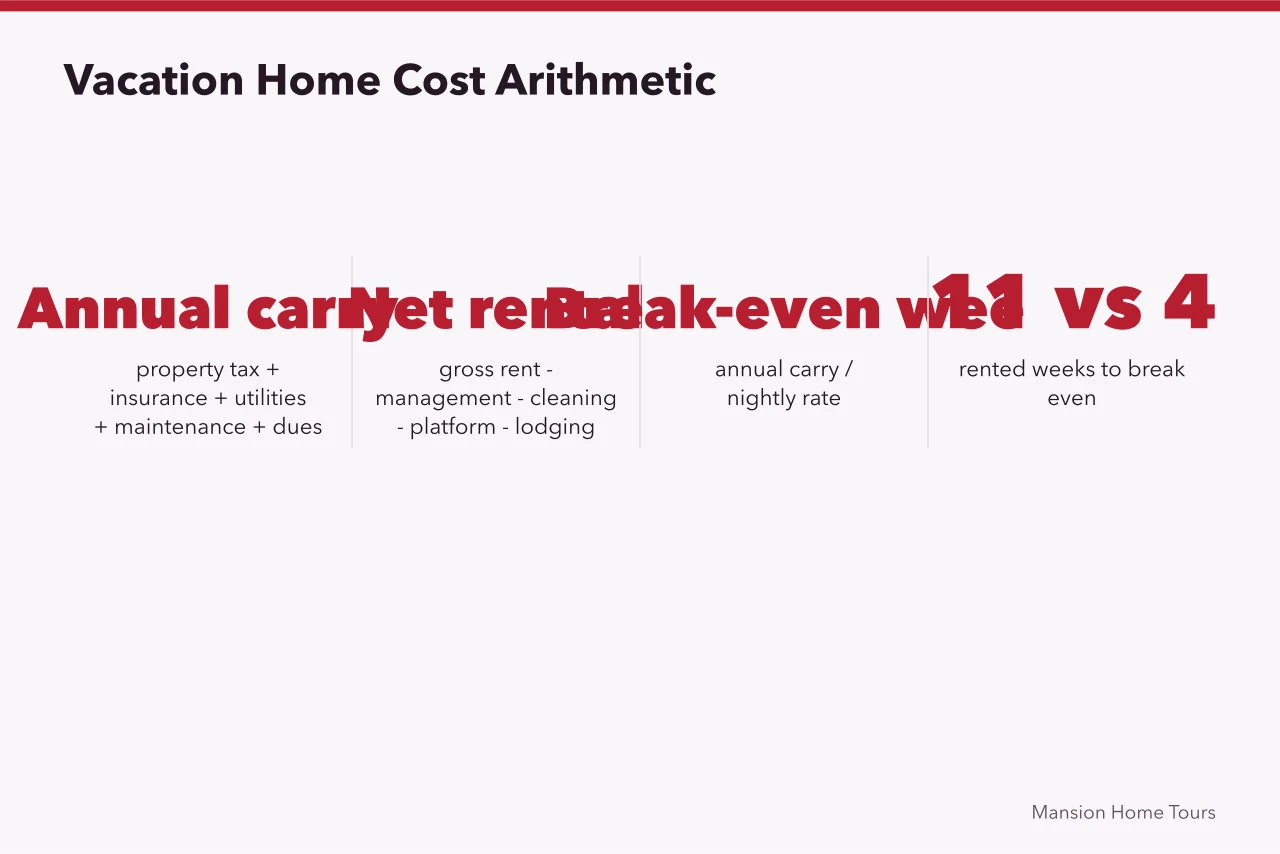
Plug in your own figures. A house that needs eleven rented weeks to break even is a different purchase from one that needs four, and the asking price does not tell you which you are buying.
As an illustration, a $750,000 Cape Cod house with tax near $6,000, coastal insurance near $4,000 and utilities and yard work near $6,000 carries about $16,000 a year before the mortgage, management and dues. Swap in the county's current rate and a real management bid before you rely on it.
What Cape Cod, Park City, the Hamptons, Hilton Head and the Outer Banks charge
What the markets charge
| Market | Median sale price, single-family | Dominant extra cost | Resale friction |
|---|---|---|---|
| Cape Cod, MA | Typically $700,000 to $850,000 | Coastal insurance, flood zone; wind deductible 2% to 5% | Seasonal listing window |
| Park City, UT | Typically $2M to $3M | HOA and club dues, often $500 to $1,500 a month | Buyer pool tied to ski season |
| Hamptons, NY | Typically $1.2M to $1.8M | Transfer tax, carrying cost; Peconic Bay adds 2% | High price band, thin winter demand |
| Hilton Head, SC | Typically $650,000 to $900,000 | Association dues, insurance; 6% assessment ratio against 4% | Steady, slower appreciation |
| Outer Banks, NC | Typically $600,000 to $850,000 | Flood and wind insurance; 6% Dare County occupancy tax | Hurricane insurance market, seasonal listing window |
Two costs sit outside that table and catch out-of-state buyers. New York collects a transfer tax from the seller at $4 per $1,000 of price, plus a mansion tax of 1% to 3.9% on New York City sales above $1 million.
The Peconic Bay Community Preservation Fund adds a 2% transfer tax, paid by the buyer, in Southampton, East Hampton, Shelter Island, Riverhead and Southold. South Carolina assesses non-owner-occupied property at 6% of value against 4% for a primary residence.
Utah's 45% residential exemption applies only to a primary residence, so a Park City second home is taxed on the full assessed value.
None of that is advice on your filing position. It names the jurisdiction and the tax. Confirm the current rate with the county assessor and a CPA licensed in that state.
The regulation that changes the return
A house rented by the night is regulated as a use, not as a building. Barnstable County on Cape Cod, Summit County around Park City, Suffolk County in New York and Beaufort County in South Carolina each handle short-term rental differently, and each revises the rules on its own schedule.
Four systems apply separately:
- Zoning and land use, which decides whether the use is allowed at all. The method for reading a district and the layers over it is in reading a zoning district, and one large jurisdiction's base districts are set out in the Los Angeles zoning overview.
- Registration or licensing, which attaches conditionsa local contact, occupancy caps, parking and waste rules. Provincetown and Barnstable issue rental certificates, Park City requires a business license and a nightly rental license, and Hilton Head Island requires a short-term rental permit.
- Building and fire code, where changing the use can change the occupancy classification and with it exits, alarms and separation. The model documents behind most residential requirements are at the International Code Council's code library, and the locally adopted version governs.
- Assessment classification, which can turn on occupancy status. What an assessment record does and does not describe is in what an assessment record measures.
Rental tax follows the rental income. Massachusetts charges a 5.7% state rooms tax, a local option of up to 6%, and a 2.75% Cape Cod and Islands Water Protection Fund surcharge in Barnstable, Dukes and Nantucket counties.
New York requires hosts of stays under 30 days to register with the state Division of Housing and Community Renewal. North Carolina's Vacation Rental Act, Chapter 42A, requires a written rental agreement and covers deposits and expedited eviction.
A prohibited use makes every other answer irrelevant, so ask that question first.
Where the money actually goes
The gap between asking price and outcome shows up in three places.
Carrying cost runs whether the house is used or not. A property held for eight weeks a year still pays twelve months of tax, insurance and maintenance.
Exit cost runs at sale. Agent commission typically runs 5% to 6% of price, and transfer tax applies. Several states withhold tax from non-resident sellers at closing, settled when the return is filed; Vermont withholds 2.5% of the sale price.
Regulation risk runs on the rental side. A rule adopted after you buy can remove the rental income the purchase was underwritten on, and it can do so in a single council cycle.
Why an intermittently used house behaves differently in the first place is covered in vacation homes, and what exposure demands of the building fabric regardless of occupancy is in details for exposed settings.
Common questions
Does the asking price predict the annual cost?
No. Two houses at the same price in the same town can carry very different annual costs, because insurance zone, association dues and tax classification are property-specific. Run the carry arithmetic on each one separately.
Which figure should I trust for a market median?
The county registry or the local listing service, pulled on the day you look. Published medians lag by a quarter or more, and a median describes the market rather than the house you are touring.
Can I rent the house out to offset the carry?
Only if the use is permitted where the house sits, which is a zoning question before it is a financial one. Check the district, the registration requirement and any private covenant, then confirm with the local planning office.
Who should I ask about the tax treatment?
A CPA licensed in the state where the property sits, and the county assessor for the classification. Non-resident withholding, transfer tax and assessment ratios vary by state and are not something to settle from a general guide.